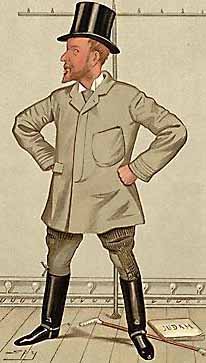
To Henry Arthur Jones, more than to any other single force, [was] due that Renaissance and "uplift" -- let the term be accepted in its best sense -- of the English drama [of his day]. Jones carried on the tradition of Congreve and Sheridan in high comedy. His best work, with the exception of Michael and His Lost Angel, consists of comedies of manners. The Liars, The Case of Rebellious Susan, and Dolly Reforming Herself, satires on contemporary society, are among the finest character plays of the day. Jones's work is characterized by close observation of the foibles of the upper classes and the aristocracy of England; a keen sense of humor -- as opposed to the cleverness and wit of Wilde and Pinero -- which brings him much closer to the English Restoration dramatists than any other of his day; and a keen sense of dramatic construction. Jones [wrote] many comedies, but his melodramas -- especially The Silver King and The Middleman -- and his tragic play, Michael and His Lost Angel -- must be taken into account in any estimate of the dramatist's total output.
(The following biography was originally published in A Short History of the Drama. Martha Fletcher Bellinger. New York: Henry Holt & Company, 1927. pp. 308-9.)
HENRY ARTHUR JONES offered his first play, A Clerical Error, in 1879. Like Pinero, Mr. Jones learned his technique from the French. In 1884 he adapted Ibsen's Doll's House for the English public under the title Breaking a Butterfly. It would be a bold person today who would offer any "adaptation" whatever of Ibsen, and with such a title! At the time, however, adaptations were in order, and Ibsen was then only another European playwright, not a theatrical prophet. Mr. Jones continued his work with domestic comedy and social pieces, including The Masqueraders and The Bauble Shop. In 1896 he wrote Michael and His Angel, generally considered his strongest drama. It is a study of small-town people, concerned with the expiation of guilt. It is both sentimental and romantic, with the solemn attitude towards sexual irregularity which generally characterized the Victorian writer. Mr. Jones, however, has shown a kind of evangelistic spirit in regard to the stage: a perception of its possible nobility and truth, and a desire to contribute to its ethical and moral value.
Broadway Productions:
Mrs. Dane's Defense [Revival, Play, Drama]
Feb 6, 1928 - Feb 1928
Cock o' the Walk [Original, Play]
Dec. 27, 1915 - Feb. 1916
The Liars [Revival, Play]
Nov. 9, 1915 - [unknown]
The Lie [Original, Play]
Dec 24, 1914 - May 1915
Mary Goes First [Original, Play]
Nov 2, 1914 - Nov 1914
The Goal [Original, Play]
Oct. 17. 1914 - Jan. 2, 1915
Lydia Gilmore [Original, Play]
Feb. 1. 1912 - Feb. 1912
We Can't Be as Bad as All That [Original, Play]
Dec. 30, 1910 - Jan. 1911
The Evangelist [Original, Play]
Sept. 30, 1907 - Oct. 1907
The Hypocrites [Original, Play, Drama]
Aug. 30, 1906 - Feb. 1907
The Middleman [Revival, Play]
Dec. 11, 1905 - [unknown]
The Middleman [Revival, Play]
Jan. 23, 1905 - [unknown]
The Case of Rebellious Susan [Revival, Play]
Jan. 9, 1905 - Jan. 1905
Joseph Entangled [Original, Play, Comedy]
Oct. 10, 1904 - Dec. 1904
The Whitewashing of Julia [Original, Play, Comedy]
Dec. 2, 1903 - Jan. 1904
The Middleman [Revival, Play]
Dec. 2, 1902 - [unknown]
Mrs. Dane's Defense [Original, Play, Drama]
Dec. 31, 1900 - Apr. 1901
The Middleman [Revival, Play]
Dec. 31, 1900 - [unknown]
The Manoeuvres of Jane [Original, Play, Comedy]
Nov. 27, 1899 - Feb. 4, 1900
The Liars [Original, Play, Drama]
Sept. 26, 1898 - [unknown]
The Physician [Original, Play]
Oct. 4, 1897 - [unknown]
The Rogue's Comedy [Original, Play]
Dec. 7, 1896 - [unknown]
Michael and His Lost Angel [Original, Play, Drama]
Jan. 15, 1896 - Jan. 1896
The Case of Rebellious Susan [Original, Play, Comedy]
Dec. 29, 1894 - [unknown]
The Masqueraders [Original, Play, Drama]
Dec. 3, 1894 - March 1895
The Bauble Shop [Original, Play, Comedy]
Written by Henry Arthur Jones Sept. 11, 1894 - Dec. 11, 1894
The Dancing Girl [Original, Play]
Aug. 31, 1891 - Nov. 1891