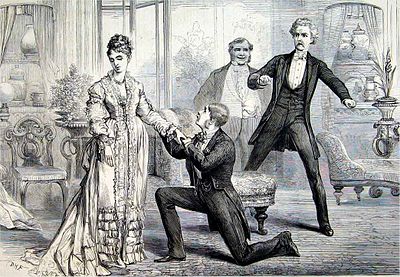
People's Theatre
St. Paul, Minnesota

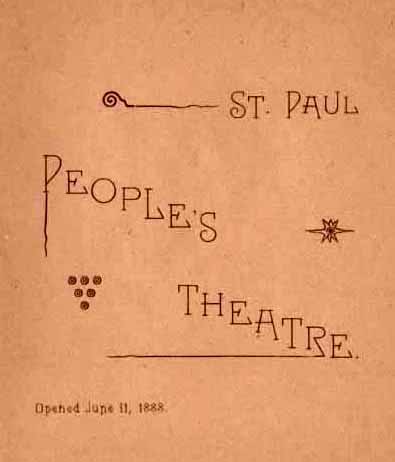
first page of opening night program; June 11, 1888
_____________________________
_____________________________
MINNESOTA HISTORY
VOLUME 23 • PUBLISHED IN Dec. 1942 • NUMBER 4
Theatrical Personalities of Old St. Paul
Frank M. Whiting
Some of the difficulties encountered when such halls were used for theatrical purposes may be surmised from a letter of Sara Fuller, a member of a pioneer St. Paul family, in which she tells of attending a performance in the Empire Block:
According to one description, Van Liew's theater "cost the modest sum of $750. The sides were of rough boards, the roof of canvas. . . . The interior of the theater was as primitive as the days. There were no galleries. The floor raised gradually toward the rear, was seated with benches. The stage was cramped and small, and there was little attempt at decoration." A photograph of the exterior, in the possession of the Minnesota Historical Society, seems to bear out this description.
The statement that it had no galleries, however, appears to be an error, since daily advertisments listed admission to the "colored gallery" at twenty-five cents. Nothing is known of the lighting except that there were footlights, a fact deduced from an account of how a Chippewa Indian walked to the footlights and presented the star. Miss Henrietta Irving, with a diamond ring valued at seventy-five dollars. Van Liew brought an extensive wardrobe, good properties, and stage settings from Dubuque, Iowa, where he had been associated earlier with the Julien Theater.
The People's Theater was completed and ready to open on June 27, 1857. Van Liew had assembled a capable company, which included William S. Forrest, brother of the great Edwin Forrest, as stage manager, and R. E. J. Miles, later a producer of national importance, as prompter. For the first six weeks Van Liew encountered keen competition. Sallie St. Clair and her Varieties were at the height of their popularity, a third theater was opened and variety entertainment was abundant.
Then early in August the financial panic struck the town. All other forms of entertainment quickly melted away, but Van Liew continued, keeping his doors open in spite of hard times and empty seats. Finally, on October 19, 1857, even Van Liew had to give up, but not permanently. With the return of warm weather he was ready for the opening of a new season. Most of his original players returned, and to these Van Liew added the Old Gent's Band.
Dion Boucicault's new drama, The Poor of New York, which had the timely subtide "or, the Panic of 1857," was one of the important productions of the season. Another highlight was Mazeppa, which reached a sensational climax when a trained horse with Miles strapped to its back dashed wildly across the stage. The feat won the plaudits of both audiences and critics and it was soon to make the name of Bob Miles famous throughout the nation.
On September 27, 1858, the season came to a close, but on April 23 of the following year the People's Theater was reopened for its third season. Apparently Van Liew planned to make this a banner year. From May 9 to June 2 he featured Mr. and Mrs. James W. Wallack in the best season of drama and tragedy the city had yet seen. But as soon as the Wallacks left, attendance dropped off. General business conditions seem to have entered that darkest phase just before the dawn. Newspapers often printed extra pages to take care of foreclosures. Toward the end of July the company ceased to give regular performances, although special benefits continued into August.
The final blow came on September 8, 1859. A Republican political rally was in progress, when flames were discovered under the stage. The cause of the blaze was never determined. Some believed that sparks from a lamp or a lighted cigar had fallen through the rickety stage floor onto the combustible material beneath; others openly accused the Democrats of having fired the building in order to break up the rally. In any event a heavy wind soon swept the flames through the building and, although the audience escaped, nothing else could be saved. Van Liew lost everything — properties, costumes, scenery, and effects.
During the following winter he and his foster daughter, the beautiful Azlene Allen, danced, sang, and entertained whenever and wherever possible in an effort to make a living. At last Van Liew gathered up his few remaining belongings and started down the river on a barge loaded with Minnesota sand. Somewhere along the way the barge sank, leaving Van Liew penniless, but in spite of everything he went to Memphis and started over again. It is little wonder that, upon learning that he had become a proprietor of the Memphis Burlesque Opera House, a writer for a St. Paul paper lauded Van Liew as a man of irrepressible "courage and enterprise." Many years later "a St. Paul gentleman ran across him at Deadwood, gray and grizzled but almost as cheery as in the days when he catered to the elite of St. Paul in the amusement fine."
With the passing of Van Liew, the first period in the history of the St. Paul theater came to a close. Civil war soon intervened and cut short all thoughts of stage entertainment. It was not until 1864 that a regular theatrical company was again seen in St. Paul, and by that time the old plays, the old players, and the old playhouses that had stirred audiences with excitement, laughter, and tears during the 1850's had disappeared.
We are still searching for more information relating to the progress and fate of the second People's Theatre.
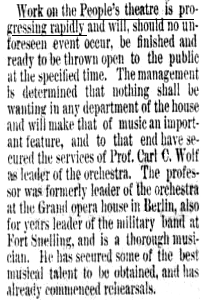
The following newspaper clippings are all we can find at present:
Linda Dietz, Lizette Le Baron, Ada Ceaves, Mary Myors, A. S. Lipman,
Charles Coote, Charles Stanley, Myron Calice, Herbert Ayling and
Harold Russell have been engaged for the company which opens at
the People's Theatre, in St. Paul, Juue 4, for tbe summer. The
repertory will include "Our Boys," "The Ticket of Leave Man," etc.
______________________________________
St. Paul Daily Globe |
(typical vintage Hazel Kirke poster) |
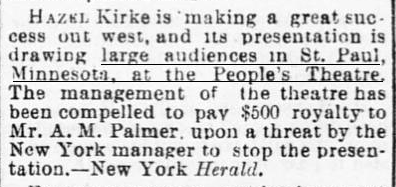
People's Theatre Fined
"The Salt Lake Herald" ___________________________
Hazel Kirke is a four-act play in written by American
Originally titled An Iron Will, the play toured
Because MacKaye revolutionized the concept of multiple
Obviously the People's Theatre was performing a "pirated"
The question is, was it actually the St. Paul theatre they |
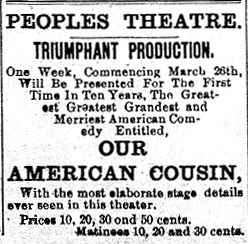
"Western Appeal" |
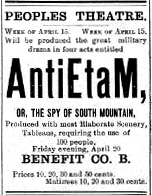
Western Appeal |
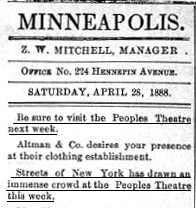
|
"Western Appeal"
(St. Paul)April 28, 1888, page 5) ___________________________
As if to press their advantage before the |
 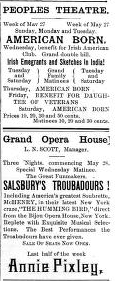
| "Western Appeal" |
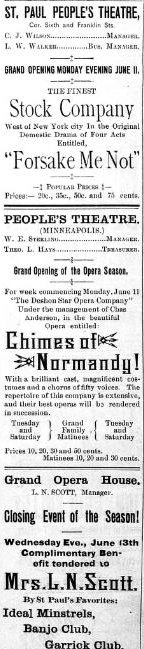
|
"Western Appeal" |
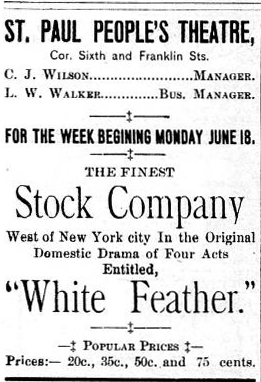
|
"Western Appeal" |
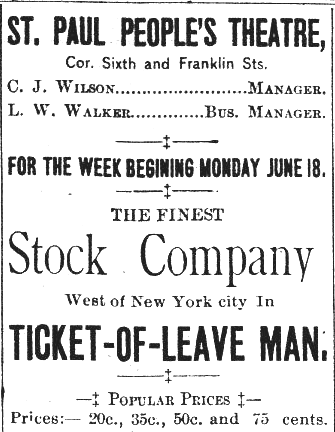
|
Western Appeal" |
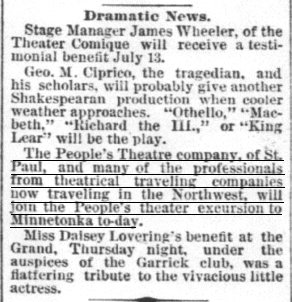
|
St. Paul Daily Globe |
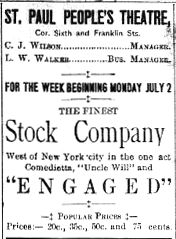
|
"Western Appeal"
|
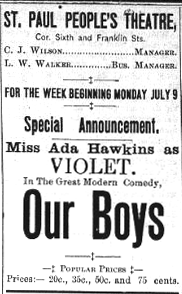
|
"Western Appeal" |
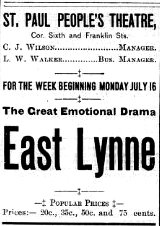
|
"Western Appeal" |
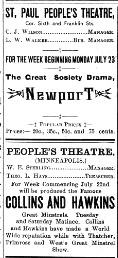
|
"Western Appeal" |
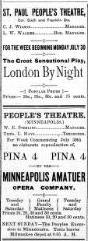
|
"Western Appeal" |
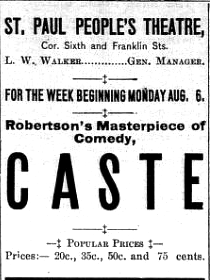
|
"Western Appeal" |
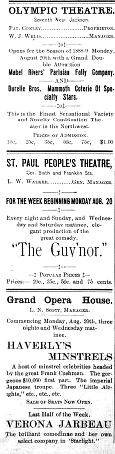
|
"Western Appeal" |
|
"Western Appeal" |
|
"Western Appeal" |
|
Western Appeal |
|
"Western Appeal" |
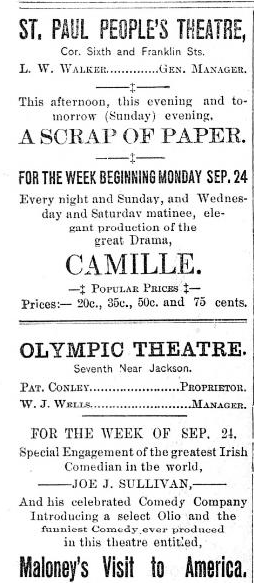
|
"Western Appeal" |
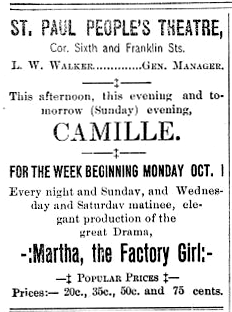
|
"Western Appeal" |
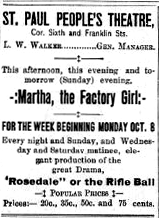
|
"Western Appeal" |
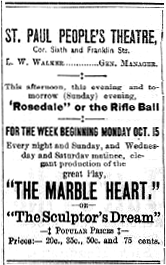
|
"Western Appeal" |
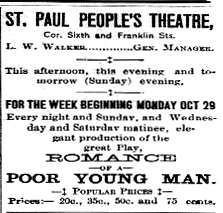
|
"Western Appeal" |
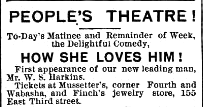
|
St. Paul Daily Globe |
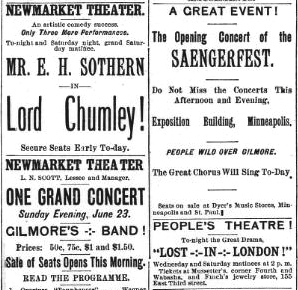
|
St. Paul Daily Globe |
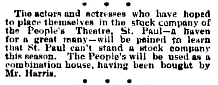
|
New York Evening World |
|
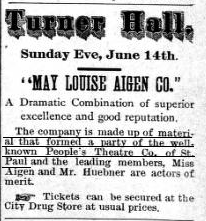
New Ulm weekly review |
|
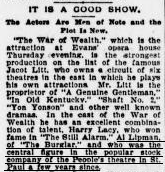
The Anaconda Standard |